
Midas M32R Manual: A Comprehensive Guide
This guide offers detailed Midas M32R information‚ including setup‚ operation‚ troubleshooting‚ and specifications‚ sourced from official manuals and PDF resources.
The Midas M32R is a powerful digital mixing console designed for both live performance and studio recording applications. Boasting up to 40 simultaneous input channels and 16 award-winning Midas PRO microphone preamplifiers‚ it delivers exceptional audio quality.
Its robust feature set includes 25 time-aligned mix buses and AES50 networking‚ supporting up to 96 inputs and outputs. The open architecture anticipates future 96 kHz operation‚ ensuring longevity and adaptability. This console represents a professional-grade solution for demanding audio engineers.
Understanding the M32R’s Core Features
Key features of the Midas M32R include its 40 input channels‚ providing ample capacity for complex setups. The console’s 16 Midas PRO preamps ensure pristine sound quality. AES50 networking facilitates seamless digital audio transport with up to 96 channels.
Furthermore‚ 25 mix buses offer extensive routing options‚ and the open architecture supports future upgrades. Its digital signal processing capabilities and flexible matrix mixing contribute to its versatility‚ making it ideal for diverse applications.
Setting Up Your Midas M32R
Proper setup involves hardware connections‚ powering on with a system check‚ and configuring the AES50 network for optimal digital audio transmission.
Initial Hardware Connections
Begin by connecting your audio sources – microphones‚ instruments‚ and line-level devices – to the M32R’s inputs. Ensure proper cable selection (XLR‚ TRS‚ or TS) for each connection. Next‚ connect the main outputs to your amplification system or recording interface.
Crucially‚ establish the AES50 network connection to a DL series stagebox if utilized‚ enabling remote I/O expansion. Finally‚ connect a computer via USB or Ethernet for control using X32-Edit software.
Powering On and Basic System Check
First‚ verify the correct mains voltage setting on the M32R’s power supply before connecting the power cable. Then‚ power on the console using the rear panel switch. Observe the LCD screen for the boot-up sequence and system initialization.
Next‚ confirm audio input and output functionality by sending a signal through a channel and monitoring the output levels. Check for proper meter response and ensure all connected devices are functioning correctly.
Network Configuration (AES50)
AES50 networking enables high-channel-count audio transmission. Access the “Network” menu on the M32R’s LCD to configure AES50 settings. Assign IP addresses to both the console and the DL series stage boxes. Ensure proper subnet masking and gateway settings for network communication.
Verify connectivity by pinging the stage box from the M32R. Confirm successful data transfer and audio routing within the network configuration. Proper setup is crucial for reliable multi-channel audio.

Navigating the M32R Interface
The M32R features a user-friendly interface with an LCD screen and dedicated controls. Mastering menu navigation unlocks parameter adjustments for optimal sound control.
Overview of the User Interface
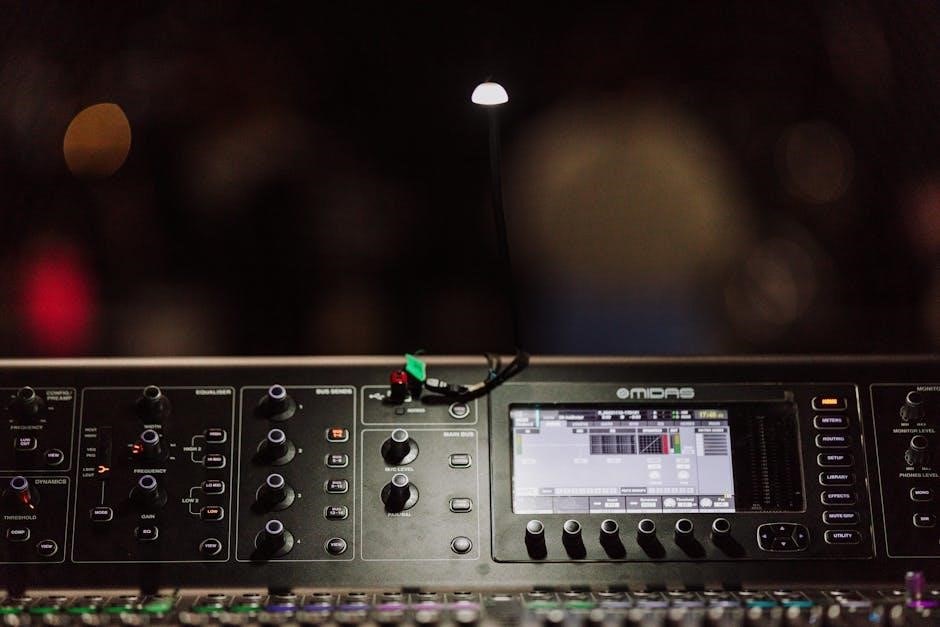
The Midas M32R’s interface centers around a high-contrast LCD screen providing clear visual feedback of parameters and settings; Physical controls‚ including rotary encoders and illuminated buttons‚ offer tactile manipulation.
These controls are logically arranged‚ allowing quick access to essential functions like channel gain‚ EQ‚ and effects. The interface is designed for intuitive operation‚ though a learning curve exists for complex routing.
Understanding the layout and function of each control element is crucial for efficient workflow and maximizing the console’s capabilities.
Understanding the LCD Screen and Controls
The M32R’s LCD screen displays comprehensive information‚ including channel levels‚ EQ curves‚ and routing configurations. Rotary encoders adjust parameters with precision‚ while illuminated buttons toggle functions and select layers.
Dedicated buttons provide direct access to key controls like mutes‚ solos‚ and faders. The screen’s contrast and brightness are adjustable for optimal visibility in varying lighting conditions.
Mastering the screen’s navigation and control layout is essential for efficient operation and unlocking the console’s full potential.
Menu Navigation and Parameter Adjustment
Navigating the M32R’s menu system utilizes the rotary encoder and LCD screen. Pressing the encoder accesses main menus‚ while rotating selects categories. Submenus are entered with another press‚ and values adjusted via rotation.
Parameter adjustment involves selecting the desired function and rotating the encoder to modify its value. The LCD displays real-time feedback.
Understanding the hierarchical menu structure and encoder functionality is crucial for customizing the console’s settings and achieving desired sound.

Input Channel Configuration
Configure microphone preamps‚ gain staging‚ EQ‚ and dynamics for optimal input levels. This section details setting up each channel for pristine audio quality.
Configuring Microphone Preamplifiers
Midas M32R boasts award-winning MIDAS PRO microphone preamplifiers‚ crucial for high-quality sound. Begin by selecting the appropriate input source for each channel. Carefully adjust the gain to achieve a strong‚ clean signal without clipping. Monitor input levels closely using the channel’s meter.
Phantom power (+48V) can be enabled for condenser microphones. Utilize the high-pass filter to reduce unwanted low-frequency noise. Proper preamp configuration is fundamental for a professional sound‚ ensuring optimal signal-to-noise ratio and clarity.
Setting Gain Staging and Input Levels
Proper gain staging on the Midas M32R is vital for optimal audio quality. Start with the channel fader down and the gain control at its minimum. Gradually increase the gain while monitoring the input meter‚ aiming for a healthy signal peaking around -12dBFS.
Avoid clipping at all costs! Adjust the input trim for each source. Consistent gain staging throughout the signal path minimizes noise and maximizes dynamic range‚ resulting in a cleaner‚ more professional mix.
Utilizing Input EQ and Dynamics
The Midas M32R provides powerful input channel EQ and dynamics processing. Utilize the fully parametric EQ to shape the tonal characteristics of each source‚ addressing unwanted frequencies and enhancing clarity. Employ the compressor to control dynamic range‚ ensuring consistent levels and adding punch.
Experiment with the gate to reduce noise and tighten up signals. Subtle adjustments are key; avoid over-processing‚ aiming for natural-sounding results that complement the overall mix.

Mix Bus Configuration
Configure mix buses for subgroups or main outputs‚ applying EQ and dynamics for cohesive sound. Route signals and utilize aux sends for effects.
Creating and Routing Mix Buses
The M32R allows creation of up to 25 mix buses‚ offering flexible routing options for subgroups‚ effects sends‚ or main outputs. To create a bus‚ assign input channels to it within the routing matrix.
Carefully consider signal flow when routing; buses can feed other buses or directly to outputs. Utilize the bus sends on each input channel to control the signal level sent to each mix bus. Proper gain staging on buses is crucial for optimal sound quality and headroom.
EQ and Dynamics on Mix Buses
Each mix bus on the M32R features fully parametric EQ‚ allowing precise tonal shaping. Utilize the EQ to correct frequency imbalances or enhance specific instruments within the mix. Dynamics processing‚ including compression and limiting‚ controls dynamic range.
Apply compression to glue elements together or limit to prevent clipping. Careful adjustment of threshold‚ ratio‚ attack‚ and release times is essential for transparent and effective dynamics control on each mix bus.
Aux Sends and Effects Routing
The M32R provides multiple aux sends for creating monitor mixes or feeding external effects processors. These sends are configurable pre- or post-fader‚ offering flexibility in routing signals; Utilize the built-in effects‚ or route signals to external units via the aux sends.
Effects returns are easily integrated into the mix‚ allowing for reverb‚ delay‚ and other creative processing. Careful gain staging on both sends and returns ensures optimal signal levels and minimizes noise.

Digital Signal Processing (DSP)
The M32R’s powerful DSP enables onboard effects like delay and reverb‚ plus compression and limiting‚ enhancing audio quality and creative control.
Using the Built-in Effects
The Midas M32R boasts a comprehensive suite of built-in digital signal processing (DSP) effects. These include high-quality reverbs‚ delays‚ chorus‚ flanger‚ phaser‚ and more‚ offering versatile sonic shaping options. Access these effects through the effects slots on each channel or mix bus.
Parameters are easily adjustable via the LCD screen and controls‚ allowing precise tailoring of each effect to suit your specific needs. Experiment with different combinations and settings to achieve desired results‚ enhancing live performances or studio recordings.
Delay and Reverb Settings
The M32R’s delay effects offer adjustable time‚ feedback‚ and mix controls for creating echoes‚ slapback‚ and complex rhythmic patterns. Reverb options range from room simulations to plate and hall algorithms‚ each with decay time‚ pre-delay‚ and EQ parameters.
Fine-tune these settings to achieve natural ambience or dramatic spatial effects; Utilize the dedicated reverb and delay sends for flexible routing and control over signal processing within your mixes‚ enhancing depth and clarity.
Compression and Limiting Techniques
The M32R provides versatile compression and limiting tools for dynamic control. Compression reduces dynamic range‚ adding punch and consistency to signals like vocals and drums. Adjust threshold‚ ratio‚ attack‚ and release times for precise shaping.
Limiting prevents signals from exceeding a set level‚ protecting downstream equipment and maximizing loudness. Employ these techniques subtly for natural sound or aggressively for impactful effects‚ ensuring a polished and professional mix.
Routing and Matrix Mixing
The M32R’s routing matrix enables complex signal flows‚ offering flexible output configurations. Utilize the matrix mixer for customized monitoring and diverse speaker setups.
Understanding the Routing Matrix
The Midas M32R’s routing matrix is a powerful tool for directing signals from any input to any output. It allows for incredibly flexible configurations‚ enabling complex signal paths tailored to specific live or studio needs. Each input can be sent to multiple destinations‚ and outputs can be fed from various sources.
Understanding the matrix involves recognizing its grid-like structure‚ where rows represent inputs and columns represent outputs. Adjusting levels within the matrix determines the signal strength sent to each destination. This granular control is essential for creating precise mixes and monitoring setups.
Creating Complex Signal Flows
The M32R excels at handling intricate audio routing. Utilize the routing matrix to build sophisticated signal chains‚ sending inputs to multiple mix buses for layered processing. Employ aux sends for creating monitor mixes or feeding external effects units.
Experiment with matrix mixing to derive custom outputs‚ combining signals from various sources. This allows for unique speaker configurations or creating dedicated feeds for broadcast or recording. Careful planning and labeling are crucial for managing complex flows effectively.
Utilizing the Matrix Mixer for Flexible Outputs
The M32R’s matrix mixer provides unparalleled output flexibility. Assign any input or mix bus to any physical output‚ creating customized mixes for diverse applications. This is ideal for zoned sound systems‚ broadcast feeds‚ or unique monitoring scenarios.
Control output levels independently‚ ensuring optimal signal delivery to each destination. Utilize the matrix for creating submixes sent to specific speaker groups. Careful gain staging within the matrix is vital for maintaining a clean and dynamic signal path.

Saving and Loading Scenes
Scenes store all M32R settings‚ enabling quick recall of setups. Create‚ manage‚ compare‚ and merge scenes for efficient workflow and consistent performance.
Creating and Managing Scenes
The Midas M32R allows for the creation of numerous scenes‚ effectively capturing and storing complete console configurations. To create a scene‚ navigate to the ‘Scene’ menu and select ‘Save’. Name the scene descriptively for easy identification.
Managing scenes involves loading‚ deleting‚ and copying them. Utilize the ‘Load’ function to instantly recall a saved setup. The ‘Delete’ option removes unwanted scenes‚ while ‘Copy’ duplicates existing ones for modification. Regularly backing up scenes is crucial to prevent data loss‚ ensuring your preferred settings are always available.
Recall of Scene Settings
Recalling scenes on the Midas M32R is straightforward. Access the ‘Scene’ menu and select ‘Load’. A list of saved scenes will appear; choose the desired scene to instantly restore all associated parameters – EQ‚ dynamics‚ routing‚ and more.
Be mindful that loading a scene overwrites the current console state. Utilize scene comparison features (if available) to preview changes before applying them. Ensure proper gain staging after loading‚ as levels may differ between scenes.
Scene Comparison and Merging
The Midas M32R facilitates scene comparison‚ allowing users to preview differences before loading. This feature highlights parameter variations between the current scene and the selected scene‚ preventing unwanted changes.
Scene merging enables selective application of settings from one scene to another. Choose parameters to merge‚ avoiding a complete overwrite. This is ideal for combining elements from multiple scenes‚ creating customized setups efficiently.
Advanced Features
Explore the M32R’s capabilities with X32-Edit software‚ OSC/MIDI remote control‚ and ensure optimal performance through regular firmware updates and maintenance procedures.
Using the X32-Edit Software
X32-Edit provides comprehensive off-line control and editing capabilities for the Midas M32R. This powerful software allows for detailed scene creation‚ parameter adjustments‚ and system configuration from a computer.
Users can remotely control the mixer‚ monitor signal flow‚ and save/load scenes efficiently. X32-Edit facilitates complex routing configurations and offers a visual representation of the console’s settings‚ streamlining workflow for both live sound and studio applications. Download it from the official Midas website.
Remote Control via OSC and MIDI
The Midas M32R supports remote control via both OSC (Open Sound Control) and MIDI protocols‚ expanding its integration possibilities. OSC enables control from a wide range of devices and software‚ offering flexible customization.
MIDI allows integration with existing MIDI controllers and systems for tactile control. These protocols facilitate automation‚ remote operation‚ and synchronization with other equipment‚ enhancing workflow for complex setups and live performances. Detailed protocol information is available in the console’s manual.
Firmware Updates and Maintenance
Regular firmware updates are crucial for maintaining optimal Midas M32R performance and accessing new features. Updates are typically available via the official Midas website and can be installed through the X32-Edit software or USB.
Proper maintenance‚ including regular backups of scenes and settings‚ is recommended. Periodically check connections and ensure adequate ventilation to prevent overheating. Refer to the manual for detailed instructions on update procedures and maintenance guidelines.

Troubleshooting Common Issues
This section addresses typical Midas M32R problems like audio dropouts‚ network issues‚ and display malfunctions‚ referencing the manual for solutions.
Audio Dropouts and Signal Loss
Experiencing intermittent audio or complete signal loss with your Midas M32R? First‚ verify all cable connections are secure‚ checking both ends. Consult the manual for proper gain staging; incorrect levels can cause clipping and dropouts.
Investigate potential network congestion if using AES50. Ensure sufficient bandwidth and check for conflicting devices. Examine the routing matrix within the M32R to confirm signals are correctly routed to the intended outputs. Finally‚ review the manual’s troubleshooting section for specific error codes.
Network Connectivity Problems
If your Midas M32R experiences network issues‚ begin by verifying physical layer connectivity – check the Ethernet cable and port status. Consult the manual for correct IP address configuration and subnet mask settings. Ensure no firewall is blocking communication between the console and your control software (X32-Edit).
Confirm that the AES50 network is properly terminated with the correct impedance. Review the manual’s network troubleshooting section for diagnostic tools and potential solutions. A firmware update‚ as detailed in the manual‚ may resolve compatibility problems.
Display and Control Issues
Should the Midas M32R’s LCD screen exhibit problems‚ consult the manual for brightness and contrast adjustments. If controls become unresponsive‚ verify proper USB connectivity if using external control surfaces. A system reset‚ as outlined in the manual‚ can often resolve software glitches affecting display functionality.
Check for firmware updates‚ detailed in the manual‚ as these frequently address control and display bugs. If issues persist‚ refer to the manual’s troubleshooting section for advanced diagnostics and potential hardware concerns.

Midas M32R Specifications
The M32R boasts 40 input channels‚ 16 Midas PRO preamps‚ and 25 mix buses‚ detailed in the manual‚ with AES50 networking capabilities.
Input and Output Channels
The Midas M32R provides a substantial channel count‚ featuring up to 40 simultaneous inputs. This includes 16 award-winning Midas PRO microphone preamplifiers‚ crucial for high-quality audio capture. Furthermore‚ the console offers 25 time-aligned and phase-coherent mix buses for flexible routing.
Output options are extensive‚ supported by AES50 networking‚ enabling up to 96 inputs and 96 outputs. The manual details how to configure these channels for diverse live sound and studio recording applications‚ maximizing signal flow and control.
Frequency Response and Dynamic Range
The Midas M32R boasts an impressive frequency response‚ delivering clear and accurate audio reproduction across the spectrum. While specific figures are detailed in the official manual‚ the console is engineered for exceptional sonic performance.
Dynamic range is equally noteworthy‚ providing a wide headroom for capturing both subtle nuances and powerful peaks. This ensures a clean and professional sound‚ even with demanding audio sources. Understanding these specifications‚ as outlined in the PDF documentation‚ is vital for optimal setup.
Physical Dimensions and Weight
The Midas M32R’s physical specifications are crucial for installation and transport. Detailed dimensions – height‚ width‚ and depth – are available within the official manual and PDF documentation. These measurements aid in rack mounting and space planning;
Weight is also a key consideration for setup crews and touring professionals. Knowing the exact weight facilitates safe handling and transportation. Referencing the manual ensures accurate logistical planning‚ preventing potential strain or damage during events.

Resources and Support
Access the official Midas website for manuals‚ downloads‚ and user forums; Find the M32R PDF manual and connect with the user community for assistance.
Official Midas Website and Downloads
The official Midas website serves as the primary hub for all M32R related resources. Here‚ you can directly download the comprehensive user manual in PDF format‚ ensuring you have the latest version readily available.
Furthermore‚ the site provides access to firmware updates‚ software downloads like X32-Edit‚ and valuable documentation to optimize your console’s performance. Explore the support section for FAQs‚ troubleshooting guides‚ and contact information for direct assistance from Midas experts.
User Forums and Communities
Engaging with online user forums and communities dedicated to the Midas M32R offers a wealth of practical knowledge and support. These platforms are invaluable for troubleshooting‚ sharing tips‚ and discovering advanced techniques from experienced users.
Benefit from collective expertise‚ find answers to specific questions‚ and participate in discussions about optimal configurations and workflow solutions. Numerous forums host downloadable scene files and custom presets‚ enhancing your mixing capabilities.
Finding the M32R Manual (PDF)
Accessing the official Midas M32R manual in PDF format is crucial for comprehensive understanding. The Midas website provides downloadable versions‚ including quick start guides and detailed operation manuals. Several third-party websites also archive these PDF documents‚ offering convenient access.
Ensure you download from reputable sources to guarantee authenticity and avoid potentially harmful files. Having the PDF readily available allows for offline reference and detailed study of the console’s features.